Meta Reality Labs
Meta Reality Labs engaged Astral City to lead a creative concepting and experience design sprint to define a north star vision for spatial shopping on Meta Quest: not a prototype, but a fully articulated concept. The brief was to find what no existing solution had delivered — a spatial shopping experience that starts with the home, uses AI to understand your space, and builds the entire retail journey around it.
Every XR shopping solution had solved a piece of the problem. None had solved all of it.
Online furniture and home decor shopping is high-friction by nature. Consumers face a paradox of choice, an inability to visualise scale and fit, and a persistent gap between aspiration and confident decision. Existing XR solutions had addressed point-in-time visualisation: place a product in your room and see how it looks. Useful, but shallow. None understood the room itself, learned the user's design taste, or remembered their choices and preferences over time. None had mapped the full journey from inspiration to ownership. That was the brief Astral City was given.
Your home is the catalogue. Shoppable, contextual and intelligent.
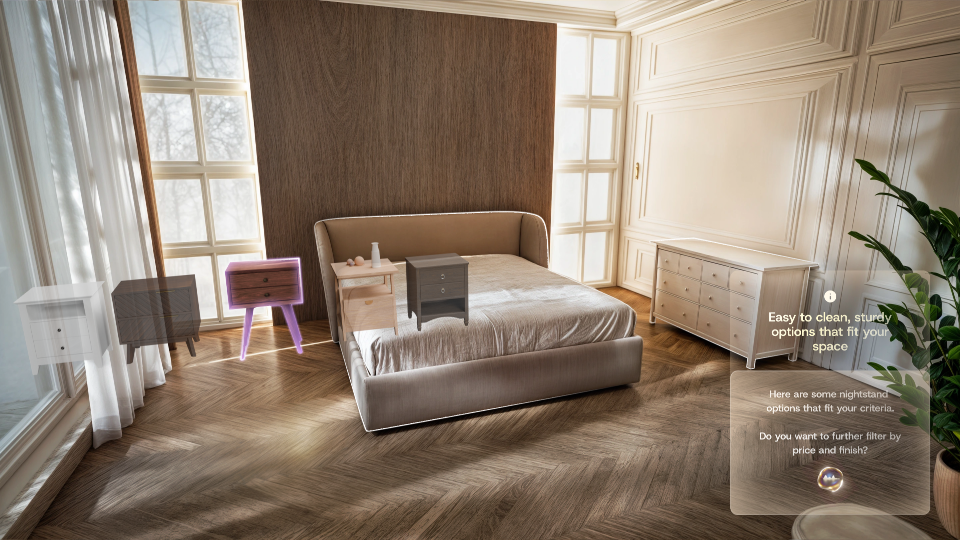
Shop XR inverts the retail paradigm. Rather than asking the user to browse a catalogue and imagine how products might look, it starts with the home: scanning, understanding and modelling the real environment, then building a personalised, AI-driven shopping experience around it. Before generating a single concept, the team mapped the full home decor purchase journey across five stages, charting every touchpoint, tool and pain point. The most important insight: the gap is not between browsing and buying — it is between visualising a product and confidently knowing it will work.
The room scan captures existing furniture and builds a spatial model of the home. Every recommendation is grounded in physical reality, not generic approximation. A scanned home shops for itself.
Not a render. The real thing, in the real space. Texture, light and scale fidelity matched to the actual environment — so the decision is grounded in something real, not an approximation.
Using voice and simple gestures, users decide what to keep, replace and buy. The experience is conversational, never menu-driven. Refinement happens naturally: "show me something lighter," "swap the chair." Voice-led refinement is not a feature. It is the interface.
The companion anticipates needs, remembers preferences across sessions, explains its suggestions and manages the path to purchase through natural conversation. It learns the user's design taste over time — getting smarter with every session.
"The gap is not between browsing and buying. It is between visualising a product and confidently knowing it will work."
Navigation is the wrong model. Conversation is.
The sprint surfaced two insights that changed how the team thought about spatial shopping. The most powerful differentiator of XR retail is not product visualisation: it is using the user's actual room as the foundation for every recommendation. And conversational refinement proved consistently more intuitive than any filter interface. The concept spawned a follow-on brief from Meta's team.
Most retail innovation makes browsing faster. Shop XR makes the decision easier. It demonstrates that the most compelling spatial shopping experience is not a better version of online retail inside a headset — it is something categorically different: a paradigm that starts with the home, uses AI to understand it, and builds a personalised, conversational experience around it. The interior design vertical is where spatial computing has the clearest immediate value. When you rethink the problem from first principles, spatial technology stops being a novelty and starts being the only sensible way to shop.
Ready to build something like this? →