
Astral City Internal
Spatial formats are emerging fast. The content opportunity is enormous: billions of hours of existing 2D video ready to be reimagined for XR, and a growing demand for new IP built spatial-first. DeepFrame is Astral City's answer — an AI-powered, no-code platform that lets creators at every scale unlock their back-catalogue, build new spatial IP, and deliver immersive experiences without specialist skills or bespoke production infrastructure.
The demand for spatial content is real. The tools to create it at scale are not.
Studios have back-catalogues worth billions. Independent creators have libraries of owned IP. Both are watching spatial formats emerge across headsets, platforms and devices with no accessible, affordable way to participate. Building spatial content today requires specialist developers, 3D artists and bespoke pipelines that cost orders of magnitude more than conventional production. The result: a format with enormous audience appetite and almost no content.
An AI-powered, no-code platform that turns existing 2D video into spatial XR experiences.
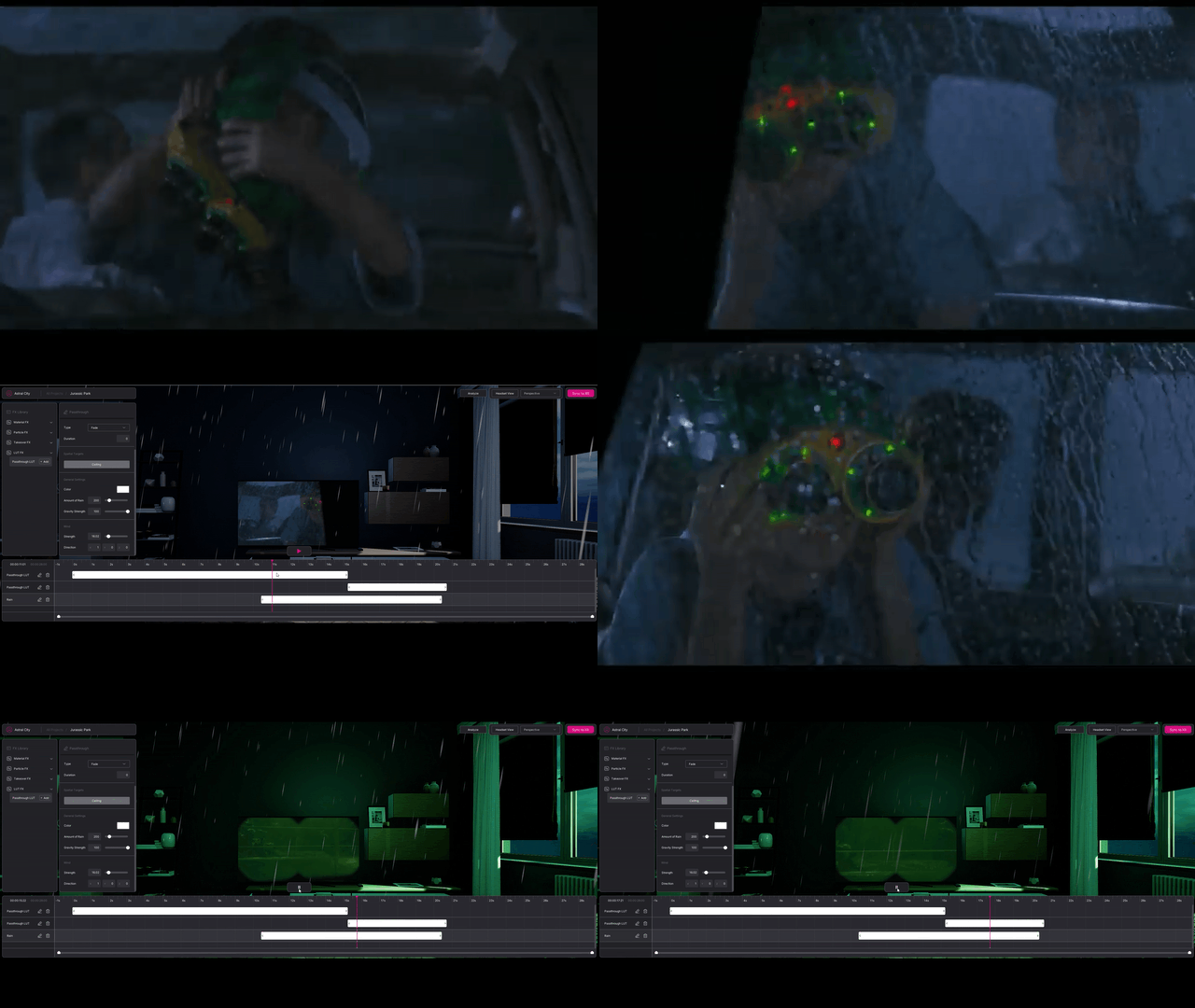
DeepFrame is a two-part system: a timeline-based Editor for building spatial augmentations, and a dedicated Player for delivering them on XR headsets. No code. No specialist skills. No rebuilding from scratch. The core insight: the world's most compelling content already exists in 2D. DeepFrame doesn't require creators to start from scratch — it empowers them to spatially augment what they already have. The product was built as a stage-managed investor demo on iOS and Meta Quest 3, proving the core loop.
Creators associate 3D models, animations and effects with precise video timestamps. Import or AI-generate assets, position them spatially, and preview in real time before export. The timeline maps to existing creator mental models — specialist skills create gatekeepers; removing them is the design intent.
An in-headset XR player lets creators see their experience exactly as audiences will, at any point in the build process. Delivered across headsets via OpenXR and WebXR for cross-platform compatibility. The in-headset Player eliminates the gap between creative intent and delivered experience.
Generate or import assets without leaving the Editor. The AI layer accelerates production without compromising creative intent — speed and creative rigour in the same tool, accessible to any creator from a major studio to an independent filmmaker.
Four distinct spatial augmentation modes that transform how a viewer experiences existing video content. Turn flat video into something that inhabits the viewer's space — without requiring new IP or specialist production. Augment what exists; start there.
"We built a spatial content platform any creator can use — from a major studio to an independent filmmaker — without touching a single line of code."
Production velocity without creative compromise.
DeepFrame changes the speed and scale at which spatial content can be produced. Creators no longer need to hand decisions to a specialist team or wait for a bespoke pipeline to catch up with their vision. The no-code editor keeps narrative control in creative hands from start to finish, the AI layer accelerates production without compromising intent, and the in-headset player closes the feedback loop instantly.
The spatial computing era is here. The content pipeline isn't. The XR content market has hardware, investment and audience appetite. What it lacks is a scalable creation pipeline accessible to the full spectrum of creators. DeepFrame addresses that gap directly: by building on existing 2D content rather than requiring spatial-native production, it unlocks the largest possible addressable content library from day one. No-code, AI-powered and built on open standards, it makes spatial content creation a realistic option for everyone from major studios to independent creators.
Ready to build something like this? →